


EDU | WORKSHOPS
University of Udine
Degree Course in Specialist and Multimedia Translation
TITLING FOR THE THEATER
Theoretical Models and Proposals for Staging in Drama and Operatic Theatre
Module lead by Mauro Conti in 2004, 2005, 2006 and 2007
1. In what context, and why, titling for theatre emerged and became an established practice.
2. Aesthetic objections raised against titling.
3. Alternative techniques to titling.
4. The idiosyncrasies of titling for theatre (surtitles) compared with titling for cinema (subtitles).
5. Titling as a service for the audience.
6. Problems rising from dual clients: the theatrical institution and the authors.
7. Timing, rhythm and dramaturgy as the main points of reference for a translation.
8. Characteristics, limits and resources of translations for theatre titling.
9. Laboratory on a theatrical production in English or German language:
– a) analysis of technical parameters
– b) timing
– c) editing of an Italian language adaptation
– d) controls and analysis of the finished work.
10. Titling as the start of a work that the audience can and should elaborate.
THE JOURNEY THROUGH THE TEXT – 1st edition
Laboratory of Theatrical Translation on «Julius Caesar» by William Shakespeare
Lead by Marisa Sestito and Michele Mirabella
Udine, Teatro Nuovo Giovanni da Udine, 16-19 May 2007
Long-running project in collaboration with the Teatro Nuovo Giovanni da Udine and University of Udine
«We follow the journey of a text» explains Marisa Sestito (lecturer in English Literature at the University of Udine), «through the metamorphoses that transform it into a script: a long and often bumpy path that moves from the original language, passes through the translation into Italian, leaves the context of prose and delivers the theatre’s words to the actor’s voice. Work on the translation is supported by interpretation of the text (historical and cultural contextualisation, critical analysis, reflexions on the peculiarities of the language) and also by attention to the musical quality of the English and Italian languages on the tongues of native speakers». Complementary laboratories explore similar sectors in parallel (adaptations for television, cinema and stage, surtitling, direction); the Shakespearean itinerary will, finally, reach Michele Mirabella’s mise en espace.
Contributors: Marzia Dal Fabbro (actress and lecturer at the Link Academy, University of Malta), Massimo Somaglino (actor and director), Elisabetta Bucciarelli (Artistic Director of CDL and Sound Art 23, Rome), Mauro Conti (Director of Prescott Studio, Florence), Carlo Gaberscek (lecturer, essayist, art historian and historian of cinema), Renato Oniga (lecturer in Latin Language and Literature).
THE JOURNEY THROUGH THE TEXT – 2nd edition
Libertine Excursions – Laboratory for Theatrical Translation
Lead by Marisa Sestito and Michele Mirabella
Udine, Teatro Nuovo Giovanni da Udine, 19-24 May 2008
Long-running project in collaboration with the Teatro Nuovo Giovanni da Udine and University of Udine
The terrain of critical investigation for translation this year refers to the English comedy of the late seventeenth century and to the figure that characterises it most: the libertine. The text that the laboratory focusses on is George Etheredge’ masterpiece, The Man of Mode (1676): a bitter-sweet comedy that shows a seducer in action, the cynical and sadistic game played on his victims, the unexpected showdown with a woman who is his match, verbally and sentimentally, and who, in the end, brings him to marry under her conditions. The text is commented, discussed, translated; the musical quality of English and Italian accompany the work on translation, thanks to the participation of actors who allow us to gather stimuli and understand the difficulty of the passage from one language to another. The final product is entrusted to the director, who will lead the text to the definitive reading. The complementary laboratories follow the libertine in his excursions through other genres and expressive forms, such as music and cinema, permitting us to verify rules and limits that condition the work and creativity of a translator.
Collaborators: Stefano Bianchi (Custodian of the Civico Museo Teatrale Carlo Schmidl in Trieste), Elisabetta Bucciarelli (Artistic Director of CDL and Sound Art 23, Rome), Mauro Conti (Director of Prescott Studio, Florence), Marzia Dal Fabbro (actress and lecturer at the Link Academy, University of Malta), Maria Paola Frattolin (President of the Associazione Itineraria, Cologno Monzese), Nadia Fusini (lecturer in English Literature, Università La Sapienza di Roma), Loretta Innocenti (lecturer in English Literature, Università Ca’ Foscari di Venezia), Francesco Pitassio (lecturer in History of the Cinema, University of Udine), Massimo Somaglino (actor and director).
Centre International de la Traduction Théâtrale, Parigi
SURTITLING – THE SPIRIT AND THE LETTER / L’ESPRIT ET LA LETTRE
Paris, Théâtre de l’Odéon, 3 February 2014
A workshop coordinated by Laurent Muhleisen and Michel Bataillon
Maison Antoine Vitez, Centre International de la Traduction Théâtrale, Paris
With the participation of Mauro Conti, Prescott Studio, Florence
«Within European culture» – writes Laurent Muhleisen in his introduction to this French initiative – «translation holds a central role; without such a mediation, disseminating works of literature would not be possible. In the theatre productions circulating across our continent, the art of translation stands out in the surtitles practice. Without this support, the reception of a performance in a foreign language is hopelessly incomplete».
«How are surtitles conceived and designed? What ‹actors› are at work on them? What skills, what steps and strategies does their achievement imply? What artistic, technical and logistical resources should be set into motion, so that everyone in the European audience be enabled to fully experience at their best the spirit and the letter of a text while attending a performance in a foreign language? To these questions the workshop [of February 3, 2014] attempts to provide an answer».
> Mauro Conti – Scripta Volant (2014)
> Portfolio
*
Casa Italiana Zerilli-Marimò, New York
MAKING THEATER INTERNATIONAL – THE ART OF SUPERTITLES
New York, Casa Italiana Zerilli-Marimò, 13 June 2014
Meeting with Mauro Conti, edited Laura Caparrotti
As part of In Scena 2014, Italian Theater Festival New York
> Claire Taddei – Reading Voices: The Art of Supertitles
*
Montclair State University, NJ, USA
College of Humanities and Social Sciences
Inserra Chair in Italian and Italian American Studies
READING FOREIGN VOICES
An Interdisciplinary Conversation about Audiovisual Translation
Film, Opera, and Theater Sub- and Sur-titles Across Languages.
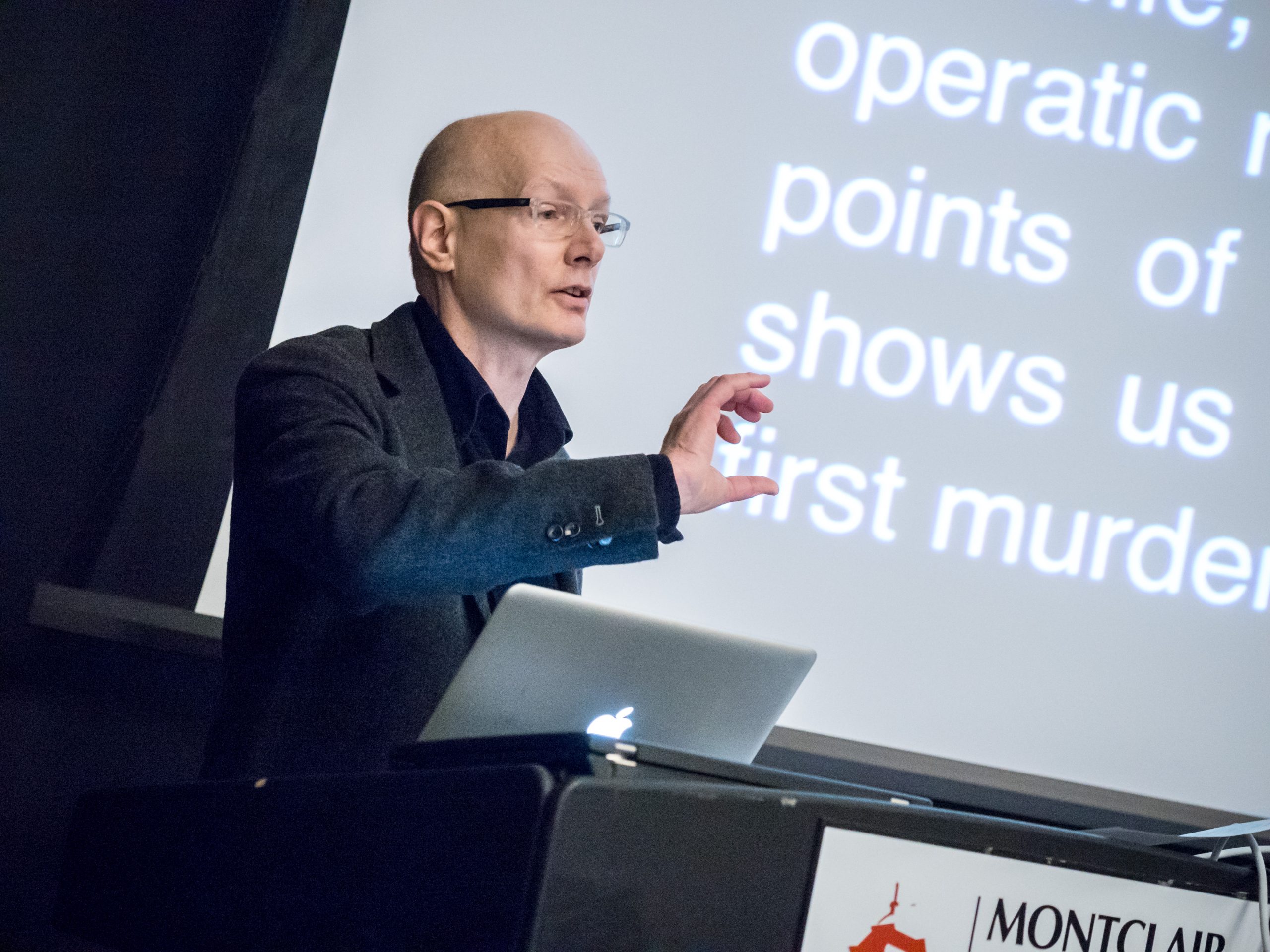
Montclair, NJ, USA, 5 December 2014
Mauro Conti participates with his own workshop
The program aims at providing a general introduction to the art and techniques of sub- and sur-titling for films, operas, and theatre performances. In combining knowledge of foreign languages, cultural awareness, aesthetic choices and technological skills, sub- and sur-titling is an ideal professional field for students of the arts and humanities with a specialization in foreign languages.
The agenda has been opened with a round table of specialists addressing the philosophy of this fascinating field, the market-based offer and demand for sub- and sur-titles, and the tricks of the trade. After a short break the program is continued with area-specific workshops during which participants could learn in detail about techniques and outcomes.
Contributors: Teresa Fiore (Inserra Chair) and Marisa Trubiano (Department of Spanish and Italian) with Mauro Conti (director of Prescott Studio, Florence), Elena Di Giovanni (Università di Macerata), Raúl Galoppe (Department of Spanish and Italian), LeeAnn Overton (Metropolitan Opera House, New York), Federico Spalletti (director of Sub-Ti, London), Fabio Troisi (Istituto Italiano di Cultura, New York), Jedediah Wheeler (director of Kasser Theater, Montclair)
> Mauro Conti – Workshop
> Mauro Conti – A Compass for the Theater
> Video
> Portfolio
Montclair State University, NJ, USA
College of Humanities and Social Sciences
Inserra Chair in Italian and Italian American Studies
ACCIDENTAL ACROBATICS
Surtitling Strategies for the Theater
Montclair, NJ, USA, 19 November 2015
A Videoconference by Mauro Conti
«Italian Translation – A Series of Talks with Experts in the Field»
The technical expedient of surtitling for the live performing arts, a descendant of the now one-century old practice of cinema subtitling, has made a significant contribution over the last 30 years to the international knowledge of theatrical productions, whether of drama or opera, through its role in facilitating the scaling of linguistic barriers.
Are specific strategies needed for the linguistic and cultural mediation that is being furthered by the recently emerged professional discipline of sur-titling? How are these different from the more familiar strategies used by subtitles? What kind of competences are required to fulfil the objectives of sur-titles? Accidental Acrobatics attempts to propose some answers to these questions.
But why «accidental acrobatics»? Because the use of written texts, accompanying theatrical events in order to make them linguistically comprehensible to an audience that does not know the language (or the languages) of a production, results in a balancing act that is not only an end in itself, having been imposed by rules that are implicit to the theatrical experience.
The keywords with which we find ourselves face to face are: 1. Time, 2. Rhythm, 3. Editing, 4. Service, 5. Rehearse, 6. Optimize, 7. Team – all categories that are usually foreign to the traditional field of translation (except Editing). This is an evidence of the uniqueness of sur-titles, in which the art of compromise, well known to translators, finds yet further incentives.
> Mauro Conti – Accidental Acrobatics
> Portfolio
*
Montclair State University, NJ, USA
College of Humanities and Social Sciences
Inserra Chair in Italian and Italian American Studies
MONTCLAIR TRANSLATES FOR MILAN VIA FLORENCE AT EXPO 2015
Techniques and Technologies for Titling Live Performances.
Final report on the Translating Voices Across Continents project
Montclair, NJ, USA, 11 December 2015
Participants: Teresa Fiore (Inserra Chair) and Marisa Trubiano (Department of Spanish and Italian) with Carlotta Brentan (Kairos Italy Theater, New York), Laura Caparrotti (director of Kairos Italy Theater, New York), Mauro Conti (director of Prescott Studio, Florence), Laurence Jay-Rayon Ibrahim Aibo (director of Center for Translation and Interpreting, MSU), Annalisa Rossini (Piccolo Teatro di Milano).
> Montclair Translates for Milan
> The Art of Compromise
> Maurita Cardone – All’Expo va in scena il teatro italiano tradotto in New Jersey
> Video
Suor Orsola Benincasa University, Naples
ACCIDENTAL ACROBATICS
Surtitling Strategies for Theatre. An AVT Case
Naples, 5 May 2016
Lecture by Mauro Conti at the international conference
«Creativity in Translation/Interpretation and Interpreter/Translator Training»
T & R Forum, Naples, Università degli Studi Suor Orsola Benincasa, 5-6 May 2016
Analised keywords: 1. Time, 2. Rhythm, 3. Editing, 4. Service, 5. Rehearse, 6. Optimize, 7. Team.
1. Time. Writing surtitles means telling a story in a time frame, which is stated by the stage through singing or acting. The story is told through a written text (to be read), which summarizes the vocal text (to be heard). The time standard combines those two parallel storytelling, keeping the written path dependent on the vocal path.
2. Rhythm. To make the time standard work together with the surtitling, it is necessary to consider its rhythmic aspect. Through that rhythm the score of a spoken or a sung text becomes a production. Identifying a rhythm which respects the staging (timing) leads to properly set up the storytelling of surtitling.
3. Editing. Editing is the most familiar phase to a translator; it recalls the editorial work of a publishing house. The editing suitable for surtitling, however, differs largely from the usual editorial review. «Editing», in surtitling, means «adaptation»: adaptation to timing, layout, reading times. And the editorial standards used in a production change for every single caption.
4. Service. Surtitling is a service provided to the audience. This service works if it integrates with listening and viewing. The main working tools, for this aim, are timing (dramaturgical tool), editing (adaptation), graphic layout (text layout) and the analysis of reading times (right fruition for the audience).
5. Rehearse. In theater, rehearsing is a practice shared by everyone, including the authors of surtitles. That means that every linguistic choice needs to be tested together with acting, singing, stage action. Moreover, surtitles have a both visual and semantic impact, which needs to be judged carefully, evaluating its graphic project, rhythm and narration.
6. Optimize. The various standards that make the surtitling working properly need to be well balanced. This balance is crucial to determine the functionality of a correct linguistic mediation for the live performing arts. However, this goal is to be achieved gradually, step by step. This process goes through phases which are separate yet closely linked.
7. Team. Making surtitles is a teamwork. Teams are made up of individuals with different skills and competences. Such working team needs to be coordinated and supervised, we could even say led by a director. What certainly should never be missing, in a team, is the spirit of compromise and the constant search for better solutions.
> Mauro Conti – Accidental Acrobatics (paper)
> Mauro Conti – Equilibrismi involontari (video)
> Creativity in Translation – T & R Forum 2016
University of Palermo
International Symposium on Translation – Fourth edition
SPECIALISTS IN THE TRANSLATION INDUSTRY.
ACROSS GENRES AND CULTURES
Edited by Alessandra Rizzo and Marianna Zummo
Palermo, Complesso Monumentale di Sant’Antonino
23 May 2019
Participants
Łucja Biel, University of Warshaw
Serenella Masidda, University of Roehampton
Annalisa Sandrelli, Università degli Studi Internazionali, Roma
Vera Arma, Director of ARTIS-Project
Carlo Caffarella, CEO of MovieReading
Mauro Conti, Director of Prescott Studio
Lonny Evans, VocalEyes, Audio Describer
The Symposium aims to explore translation issues in relation to legal texts and audiovisual products by looking at cutting-edge research in translation, on the one hand, and at the professional dimension in the translation industry, on the other. The event welcomes international scholars from various European universities and experts from well-known translation agencies and associations.
The 21st century scenario of wide multilingual and multicultural exposure, cultural and linguistic fluidity and advances in networked communication has accelerated the diversification of translation practices within different research areas. As a bridge and form of communication across cultures and languages, translation activities applied to the different varieties of texts and visuals have proliferated on digital platforms, and within public and institutional spaces. Viewed as a broad, complex and multi-faceted phenomenon encompassing linguistic, cultural and technical factors, translation is seen as a careful procedure of selection, combined with a skilful attention to text types. Investigating how new technologies are changing the global market, as well as the modalities by which we consume translation across and within languages, the scope of the symposium will be to shed light on how translation is produced, accessed and made accessible to diverse international, national and regional user groups with their varying backgrounds.
Particular attention is paid to Accessibility, Audiovisual Translation and corpus-based legal Translation Studies from the aspect of the translators’ choices in relation to the different text types, with a view to developing new tools and resources for translators, as well as providing a platform for exchanging ideas and promoting cutting-edge research in the area of translation. The numerous contributions aim to lead to an understanding of the new and old more traditional mechanisms in translation, of the pros and cons of the innovative technologies and developments and changes in the translation industry. In particular, modes of audiovisual translation such as audio description for the blind and visually impaired (ARTIS-Project, MovieReading, VocalEyes), subtitling for hearers and subtitling for the deaf and hard of hearing (GoLocalise, CulturAbile) and surtitling for the theatre (Prescott Studio) are discussed within the professional field of the translation industry.
University of Macerata
International Master Programme – Fourth Edition
ACCESSIBILITY TO MEDIA, ARTS AND CULTURE
Unit «Surtitling», held by Mauro Conti
Webinar
June-July 2024
28 June, theoretical class
29 June, practical session
4 July, workshop on practical session
1 August, test
In collaboration with: Castello di Rivoli, Museum of Contemporary Art; DEMA Solutions Srl; Omero National Tactile Museum; RAI Pubblica Utilità; SubTi Limited; Tangible Srl SB; Unione Italiana dei Ciechi e degli Ipovedenti; Consiglio Regionale delle Marche
The master of Arts in Accessibility to Media, Arts and Culture is designed to equip students with complete and effective training with an international dimension.
They will also develop a wide-ranging knowledge of accessibility and will be prepared to operate in a variety of roles in different contexts.
The programme is delivered in English. Practical activities are available in English and Italian
University of Bergamo
TRALECTIO | International Summer School 2025
TRANSLATING THE / FOR / IN THEATRE – Round Table
Webinar
5 June 2025
Participants
Laura Forti, playwright and translator
Carmelo Rifici, artistic director
Mattia Visani, CUE-Press, publisher
Mauro Conti, Prescott Studio, director
Marco Castellari, moderation
The round table offers a space for discussion on the many aspects of the translation of dramatic texts. The first part sees the participation of playwright and translator Laura Forti and director Carmelo Rifici, who will explore the crucial role of translation in the staging and performative dimension of theatre. In the second part, the focus will shift to the different typologies and functions of theatrical translation on and off the stage, thanks to the interventions of Mattia Visani, founder of Cue Press, a publishing house specialising in theatrical texts, and Mauro Conti, director of Prescott Studio, a leading agency in surtling for the live performing arts. Moderating the dialogue with the experts is Marco Castellari, Professor of German Theatre at the University of Milan.